Introduction: The Hiring Shift You Can’t Ignore
For decades, a college degree was seen as the golden ticket to career success. Parents encouraged it, employers required it, and job seekers pursued it relentlessly. Yet, in today’s rapidly evolving job market, that equation is changing. Employers are asking: Do we really need a degree for this role—or would proven skills be enough?
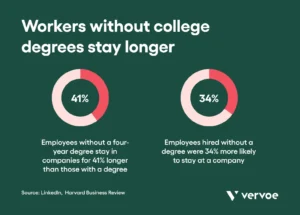
Welcome to the era of skills-based hiring—a growing trend where companies prioritize what candidates can do over the formal education they’ve received. From tech giants like Google and IBM to startups and mid-sized firms, businesses are increasingly embracing the idea that practical skills, certifications, and real-world experience often matter more than a diploma on the wall.
This shift raises an important debate: Skills-based hiring vs degrees—what should employers really be looking for now?
In this comprehensive guide, we’ll explore:
-
Why employers are moving away from degree requirements.
-
The benefits and challenges of hiring for skills over education.
-
Real-world examples of companies leading this change.
-
How job seekers can thrive in a skills-first economy.
-
FAQs that answer common concerns about this hiring evolution.
By the end, you’ll understand how employers value skills vs degrees today, and what you can do to stay ahead in the changing job landscape.
The Evolution of Hiring: From Degrees to Skills
The Traditional Degree-Centric Approach
For much of the 20th century, employers equated degrees with competence. A diploma suggested a certain level of discipline, intelligence, and subject mastery. Job postings routinely included “Bachelor’s degree required” as a baseline filter—even for entry-level roles that didn’t truly need academic training.
The reasoning was simple:
-
Screening shortcut: Degrees acted as an easy way to reduce applicant pools.
-
Perceived prestige: A university name carried credibility.
-
Assumed knowledge: Employers believed a graduate had the skills needed for the job.
But the problem? Reality often didn’t match assumptions.

The Breaking Point: Skills Gaps in the Workforce
According to a LinkedIn Global Talent Trends report, 75% of recruiting professionals believe skills-first hiring will become a priority. The reason is clear: degrees don’t always guarantee job readiness. Employers increasingly found that graduates lacked practical skills like problem-solving, teamwork, digital literacy, or industry-specific expertise.
At the same time, the digital economy accelerated demand for new skills—cloud computing, cybersecurity, UX design, data analytics—that universities couldn’t adapt to quickly enough. This mismatch forced employers to rethink hiring models.
The Rise of Skills-Based Hiring
Instead of filtering candidates by degrees, skills-based hiring focuses on demonstrated competencies. That may include:
-
Hands-on experience (internships, freelance work, personal projects).
-
Professional certifications (Google IT Support, AWS Cloud Practitioner, PMP).
-
Skills assessments (coding challenges, portfolio reviews, case studies).
-
Transferable “soft skills” (communication, adaptability, leadership).
This model opens opportunities for nontraditional candidates while helping employers fill critical roles faster.
Why Employers Are Choosing Skills Over Degrees
1. Widening the Talent Pool
By eliminating degree requirements, companies access a larger, more diverse group of candidates. This is especially important in industries facing severe talent shortages, like tech, healthcare, and skilled trades.
Case Study: In 2022, IBM removed degree requirements for over 50% of its U.S. job postings. The result? A broader applicant pool with stronger real-world skills.
2. Faster Hiring and Reduced Costs
Screening by degree can slow down the hiring process. Skills-based assessments allow recruiters to quickly identify qualified candidates, reducing time-to-hire. Additionally, employers save money by hiring candidates who can perform immediately, rather than requiring long onboarding or retraining.
3. Improved Employee Performance
Candidates selected for what they can do tend to be more effective in their roles. For example, a self-taught web developer with a strong portfolio may outperform a recent computer science graduate with no project experience.
4. Greater Workforce Diversity
Skills-first hiring levels the playing field by valuing nontraditional pathways. It benefits groups historically excluded from higher education access, promoting equity and inclusion.
5. Adapting to a Skills-Based Economy
The World Economic Forum predicts that 50% of employees will need reskilling by 2027 due to automation and AI. Employers focusing on skills now are better positioned to adapt to future workforce shifts.
Skills-Based Hiring vs Degrees: The Pros and Cons
Benefits of Skills-Based Hiring
-
Meritocracy: Talent matters more than background.
-
Flexibility: Opens doors to career changers and self-learners.
-
Future-ready workforce: Keeps pace with evolving industries.
Risks or Challenges
-
Assessment difficulty: Measuring skills consistently can be complex.
-
Perception issues: Some industries (medicine, law, engineering) still rely heavily on formal education.
-
Quality assurance: Not all certifications or training programs are equal.
Why Degrees Still Matter in Some Cases
While skills are gaining ground, degrees remain critical in regulated fields (e.g., healthcare, law) or roles requiring deep theoretical knowledge. Employers often balance both factors—valuing skills without dismissing education entirely.
What Employers Are Really Looking For Now
Hard Skills in Demand
-
Tech & Digital: Data analysis, coding, cloud computing, cybersecurity.
-
Business & Operations: Project management, financial analysis, supply chain management.
-
Creative: UX/UI design, content creation, digital marketing.
Soft Skills That Stand Out
-
Critical thinking and problem-solving.
-
Communication and teamwork.
-
Adaptability and resilience.
-
Leadership potential.
Hybrid Hiring Approach
Most companies today prefer a skills-plus-degrees model—valuing proven skills while considering education as a secondary filter. For example, a marketing role may not require a degree but will demand evidence of campaign results, creativity, and data-driven strategy.
How Job Seekers Can Succeed in a Skills-First World
-
Build a Portfolio – Showcase real projects (GitHub code, design mockups, case studies).
-
Earn Certifications – Target industry-recognized credentials.
-
Leverage Internships & Freelance Work – Prove your abilities through practice.
-
Highlight Transferable Skills – Emphasize leadership, communication, and problem-solving.
-
Tailor Your Resume for Skills – Use skill-based keywords aligned with job descriptions.
-
Stay Updated – Continually reskill to remain competitive.
Frequently Asked Questions (FAQs)
1. What is skills-based hiring?
Skills-based hiring is when employers prioritize a candidate’s abilities, certifications, and proven experiences over traditional academic qualifications like degrees. Instead of filtering candidates by education, companies use assessments, portfolios, or certifications to evaluate job readiness.
2. Why are employers shifting from degrees to skills?
Employers face skills gaps in today’s fast-changing economy. Degrees don’t always guarantee practical ability, while skills-based hiring helps companies fill critical roles quickly and more effectively. It also expands diversity by including candidates without formal education.
3. Do I still need a degree in a skills-first job market?
Not always. While degrees remain essential in regulated professions like medicine, law, or engineering, many industries—including tech, marketing, and design—are moving toward skills-first approaches. A strong portfolio and certifications can often replace a degree requirement.
4. What industries benefit most from skills-based hiring?
Technology, IT, design, marketing, sales, and skilled trades are leading adopters. These fields evolve quickly, making hands-on skills and certifications more valuable than traditional degrees.
5. How can I prove my skills to an employer?
Through portfolios, case studies, certifications, and performance in assessments (like coding tests or project simulations). Networking and strong recommendations can also validate your expertise.
6. Is skills-based hiring just a trend?
No. Industry reports suggest it’s a long-term shift. LinkedIn, Deloitte, and WEF all emphasize that the future of work depends on skills-first hiring models, especially as automation transforms job requirements.
7. What are the challenges of skills-based hiring for employers?
The main challenge is consistent assessment. Employers must design reliable methods to measure skills fairly. They also risk undervaluing the broader benefits of higher education, such as critical thinking and discipline.
8. Which is better: skills or degrees?
Neither is universally “better.” The ideal candidate often has a blend of both—relevant skills proven through work and, where necessary, formal education. The weight of each depends on the job and industry.
9. Will AI and automation make skills-based hiring more common?
Yes. As automation reshapes industries, employers need adaptable workers who can quickly reskill. AI also enables more accurate skill assessments, reinforcing the shift toward skills-first hiring.
10. How should students prepare for a skills-first job market?
Students should combine formal learning with hands-on experience—through internships, side projects, certifications, and networking. The most successful graduates will have both a degree and a portfolio of proven skills.
Conclusion: The Future Belongs to the Skilled
The age-old debate of skills vs degrees is evolving. While degrees still hold value in certain industries, the job market is increasingly skills-driven. Employers want evidence of what candidates can do, not just where they studied.
For job seekers, this shift is empowering—it means you don’t need to follow a single path to success. Whether through coding bootcamps, online certifications, or freelance work, you can demonstrate value in tangible ways.
For employers, skills-based hiring means greater efficiency, inclusivity, and adaptability in a rapidly changing economy.
Key takeaway: The future of hiring is not skills vs degrees—it’s skills plus continuous learning. If you focus on building, showcasing, and updating your skills, you’ll remain competitive no matter how the job market changes.
👉 What do you think—should employers prioritize skills over degrees? Share your thoughts in the comments below!